A Decade of Eventide (2014–Present)
 Eventide Project Team
Series
This article is part of a three-part series on the evolution of the Eventide ecosystem.
- A Decade of Eventide (2014–Present)
- The Next Generation of Eventide
- Contributing to the Next Generation of Eventide
Over the past decade, Eventide has evolved from an internal architectural approach used in production systems into a widely adopted open-source ecosystem for building evented and component-based systems. What began as practical solutions to real production problems gradually matured into a coherent architectural model, a supporting ecosystem of libraries and tools, and a growing community of engineers applying these ideas in their own work.
The timeline below highlights key milestones in that evolution — spanning the architectural foundations of Eventide, the development of its implementation ecosystem, and the broader community impact of the project.
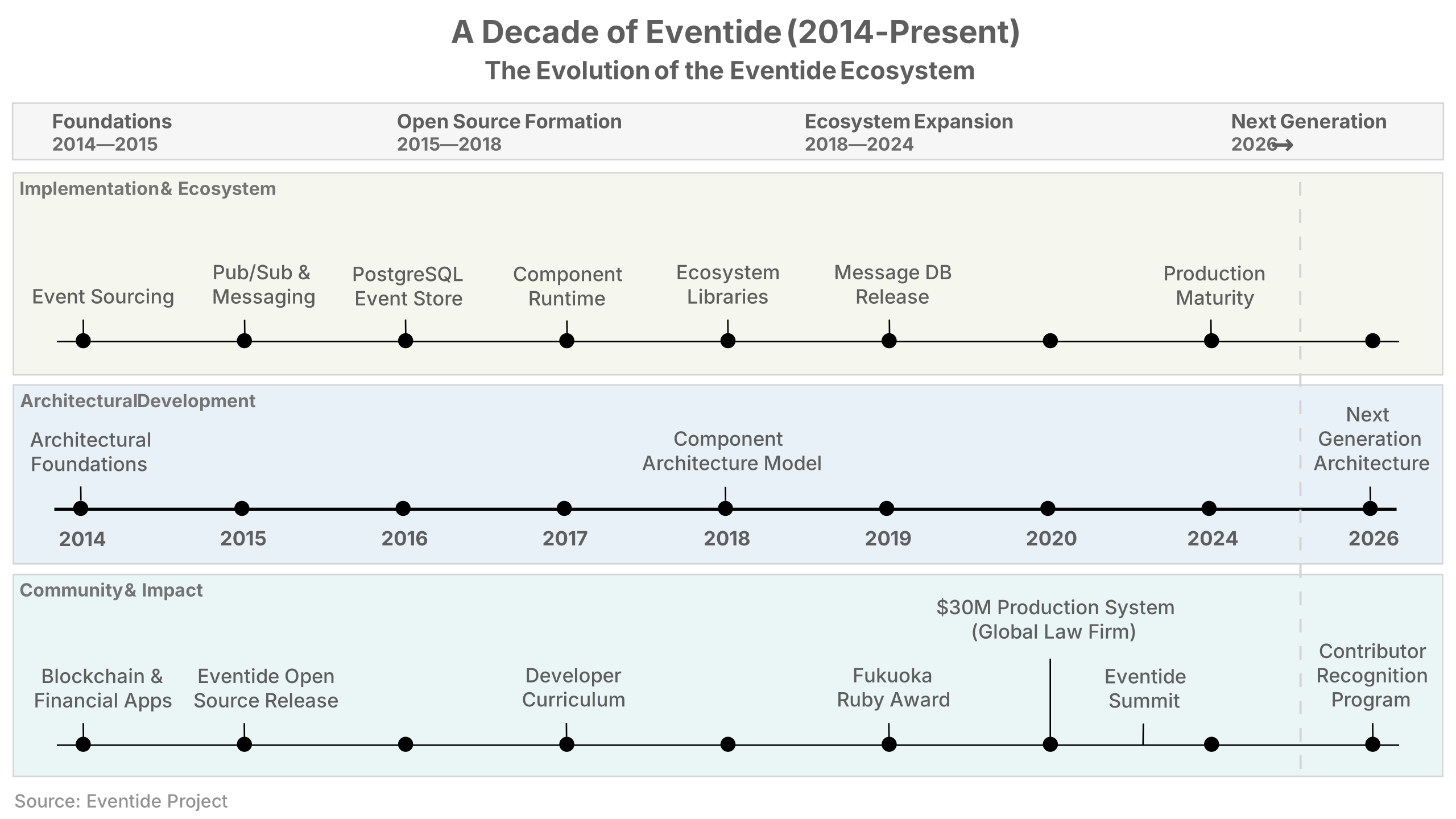
Figure — Evolution of the Eventide ecosystem (2014–Present). Major milestones in the architectural development of Eventide, the evolution of its implementation ecosystem, and the growth of the community surrounding the Eventide Project and Message DB.
What This Article Covers
Over the past decade, the Eventide ecosystem has evolved across three distinct but closely related dimensions:
Architectural Development
The architectural foundations of Eventide and the evolution of the component architecture model that underpins the ecosystem.
Implementation & Ecosystem
The development of the supporting libraries, messaging patterns, runtime components, and infrastructure that make the architecture practical for building production systems.
Community & Impact
The growth of the community surrounding Eventide, including educational outreach, real-world adoption, recognition such as the Fukuoka Ruby Award for Social Impact, and the formation of a broader ecosystem of practitioners.
Introduction
The Eventide architecture began in 2014 while building in-house blockchain and financial applications. Those systems required a reliable way to model long-running financial activity and maintain a verifiable history of state changes.
Over the following decade, the architectural patterns developed in those systems evolved into the Eventide ecosystem — an open-source framework and supporting body of tools, practices, and infrastructure for building event-sourced and message-driven applications.
Recently I reviewed the contributor history of the Eventide Project and Message DB repositories to better understand how the architecture has grown over time. The commit history reveals a clear picture of how the framework evolved and the work that shaped it.
What Eventide Is
The Eventide Project is an open-source framework for building event-sourced and message-driven systems. It provides conventions and architectural patterns for constructing systems as collections of autonomous components communicating through messages.
The framework emphasizes clear boundaries between components, explicit message flows, and the use of events as the durable record of system behavior.
Event Streams and Message DB
Event-sourced systems model state as a sequence of events stored in ordered streams. These streams provide a durable history of system behavior that can be replayed, audited, and used to reconstruct application state.
A core piece of infrastructure commonly used within the Eventide ecosystem is Message DB, a PostgreSQL-based event store designed for storing and reading event streams.
Message DB builds on the operational maturity of PostgreSQL while providing the primitives required for working with event streams, including ordered message streams, optimistic concurrency controls, and predictable mechanisms for reading and writing messages.
By building on PostgreSQL, Message DB can be operated using the same infrastructure, tooling, and operational practices that many organizations already rely on for production systems.
Message DB focuses on the minimal set of capabilities required for working with event streams, allowing application architecture to remain explicit rather than hidden behind framework abstractions.
While Message DB is commonly used with Eventide, it can also be used independently in any system that models state as a sequence of events.
The architecture and its surrounding ecosystem have evolved over many years through real-world production systems, engineering education, and the practical experience of teams building event-driven systems.
Contributor History
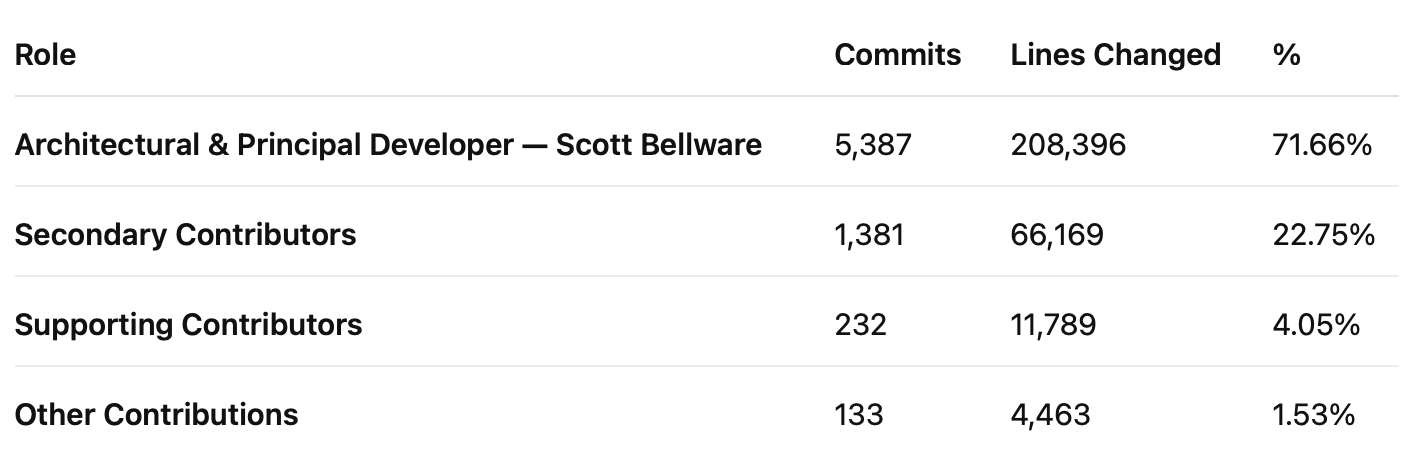
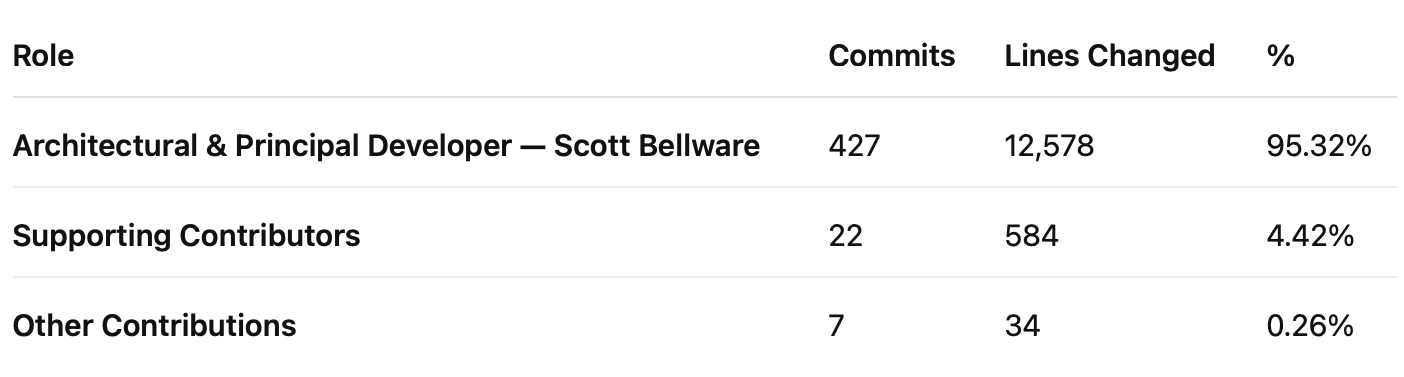
Analysis of the commit history of the Eventide Project and Message DB repositories shows a clear pattern of architectural stewardship.
Across the combined repositories, the majority of architectural and principal development work has been authored by Scott Bellware, who initiated the architecture and has maintained its development since the project began.
Based on the commit history of the repositories:
- Approximately 72% of all lines changed across the ecosystem were authored by Scott Bellware
- The remaining contributions were distributed among a small number of other contributors and occasional community patches
These numbers reflect the nature of an architecture-driven project, where the core design and implementation work has largely been performed by its original author while the broader ecosystem grows through community participation.
The repository history therefore reflects a model in which the architecture has been stewarded consistently over time while the surrounding ecosystem grows through broader participation.
Eventide Contributions
Message DB Contributions
Methodology
The contributor statistics in this analysis were derived from the complete Git history of the Eventide Project and Message DB repositories.
The analysis includes commit counts and total lines changed (additions plus deletions). Merge commits were excluded so that the metrics reflect direct development activity rather than repository maintenance operations.
Community Participation
Although the majority of architectural development has been centralized, the Eventide ecosystem has also benefited from community participation over the years through documentation improvements, example applications, bug fixes, and occasional enhancements to supporting libraries.
In addition to code contributions, the project has long emphasized outreach and education for engineers learning evented and component-oriented systems. Training materials, workshops, and direct support for teams adopting Eventide have helped developers apply these architectural patterns in their own systems.
This combination of architectural development, engineering outreach, and support for practitioners using the framework in their daily work contributed to the project receiving the Fukuoka Ruby Award for Social Impact, an international award recognizing projects that demonstrate meaningful impact through the Ruby programming language. The award reflects not only the architecture itself, but also the project’s ongoing outreach to engineers learning evented and component-oriented systems and the support provided to teams using Eventide in their daily work.
The Eventide Community Summit held in Courtenay, British Columbia in September 2023 also brought together practitioners and contributors to discuss the architecture and its future direction.
Governance
The long-term health of an open-source project depends not only on its technical architecture but also on the integrity of its community.
Following a review of conduct relative to the project’s code of ethics, some contributors are no longer participating, and their access to the project repositories has been removed.
While these contributors had participated in the project at various points in its history, their contributions represent a relatively small portion of the total development work across the ecosystem.
As the project enters the next generation of its architecture and community model, stewardship of the framework continues under the same architectural leadership that has guided its development since its inception.
AI-Assisted Contributions
As modern development increasingly incorporates AI tools, these tools can play a constructive role in helping new contributors participate in the Eventide ecosystem.
Because Eventide emphasizes strong architectural conventions and consistency, AI-assisted development can help contributors maintain naming conventions, follow the architectural patterns used throughout the framework, and align new code with the structure of existing components.
Because Eventide places strong emphasis on architectural consistency and well-defined conventions, AI tools can also help reinforce those patterns by guiding contributors toward implementations that align with the existing structure of the framework.
Used thoughtfully, AI tools can help new contributors become productive more quickly while preserving the coherence of the architecture.
Lessons from a Decade of Eventide
Looking back at more than ten years of development of the Eventide ecosystem reveals several consistent patterns about building event-sourced systems.
Architectures Mature Through Sustained Work
Coherent architectures rarely appear fully formed. They emerge through years of iteration, real-world application, and refinement.
Strong Conventions Are Essential
Event-sourced systems benefit from clear patterns that guide how components interact and how events, commands, and projections are structured.
Message-Driven Boundaries Scale Well
Systems composed of autonomous components communicating through messages allow teams and systems to evolve independently while preserving overall coherence.
Education Strengthens the Architecture
Teaching engineers how to build evented systems provides a feedback loop that helps refine the architecture and clarify its core ideas.
These lessons have shaped the development of Eventide over the past decade and will continue to guide the architecture as it evolves into its next generation.
Looking Forward
The Eventide ecosystem has now reached a point where more than a decade of practical experience can inform the next phase of its evolution.
What began in 2014 as architecture developed while building in-house blockchain and financial applications has grown into an ecosystem used by engineers learning and applying event-sourced design in real production systems.
The next stage of development builds on those lessons.
As the architecture continues to evolve, the focus shifts toward refining the patterns that have proven most effective in practice and expanding the ecosystem that supports them.
Next in the Series
In the next article, I describe how the Eventide architecture is evolving based on the lessons learned from more than a decade of development.
→ The Next Generation of Eventide